October 1, 2026
Scaling Green Skills in Africa: From TVET Pilots to Systemic Transformation
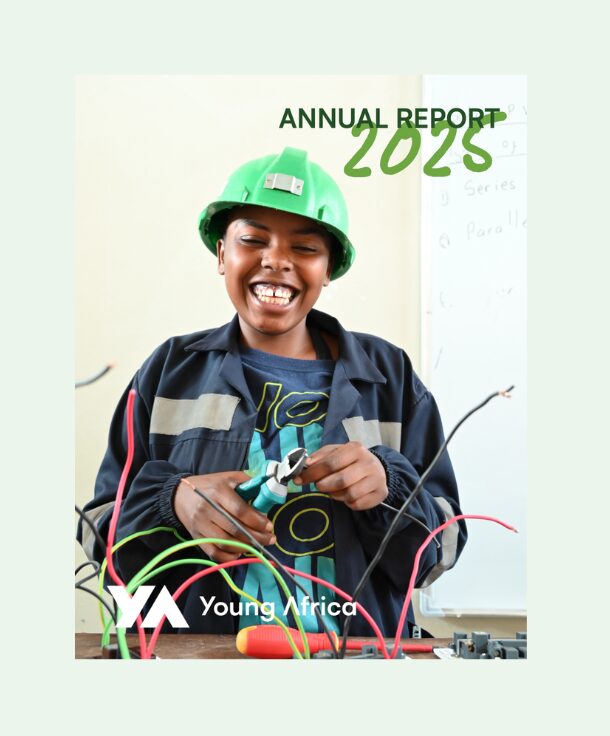
Young Africa has released its Annual Report 2025, documenting a year in which the organisation expanded into new countries, launched a first-of-its-kind e-learning platform, and helped a record number of young people move from unemployment into work of their own.
Across Angola, Mozambique, Nigeria, Zambia and Zimbabwe, enrollment in Young Africa’s TVET (technical and vocational education and training) programmes reached 7,202 students in 2025: a 24% increase on the previous year. Even more striking: 75.9% of 2024 graduates are now economically active, up from 69.4% the year before, with 63% of them financially independent.
“These numbers matter, but they are not the heart of the story,” writes CEO & Co-Founder Dorien Beurskens. She points instead to graduates like the young woman who now owns her own salon and employs eight students of her own, or the young man who “traded his gang for a trade” and used his first paycheck to put a meal on his family’s table. “These are not exceptions,” she writes. “They are the point.”
2025 brought real turbulence to the funding landscape for international development. Frans van Midde, Chairman of the Supervisory Board, notes the year unfolded against a backdrop of global political instability and the termination of US government foreign assistance programmes, challenges compounded by a documented global decline in education investment.
Young Africa responded by growing. The organisation:
The federation also deepened its commitment to sustainable practice, commissioning a biogas digester and solar system at its Chitungwiza Centre in Zimbabwe and partnering with a private waste-management firm in Angola on environmental training.
The results extend beyond employment. Among 2025 graduates, 99.7% report being able to set and pursue personal goals, 97.7% feel able to speak up about issues affecting them, and 96.8% feel more confident about their future.
These achievements sit within Young Africa’s 2024–2026 strategic plan, which aims to bring the total number of youths empowered through its programmes to half a million by the end of the period, through continued expansion into Ghana and South Africa, deeper support for past students, and a sustained focus on quality, relevance, and “greenovation” across all its work.
As Beurskens puts it in her foreword: “Teach a young person a real skill, and you change their sense of purpose, how their community sees them, how they are part of the growth of Africa.”
The full Annual Report 2025 is available now.